

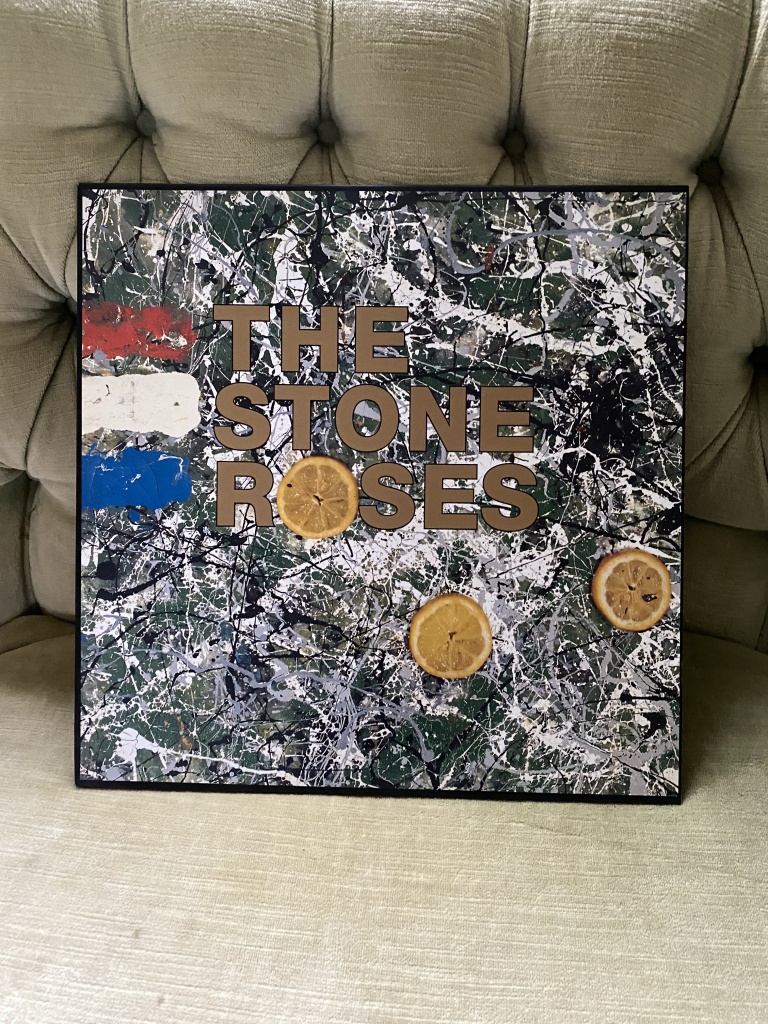
Deep into the search for self, the spinning fractals of Madchester and its descendant indie scene light the way for the troubled teenager. Thirty years after its release, The Stone Roses’ eponymous LP remains the headlamp of choice, faint rumblings of revolutionary thought and grounding in the grounded classes guiding the only-slightly edgy into an individuality. An individuality shared with a million other individuals: the originals in their moulding bucket hats (my dad), the newbies in their Brazil football shirts and gleaming white three stripes (myself), the die-hards in baggy jeans and acid wash tees, the mothers who’d rather be watching the Stones than the Roses dragged along to see their 16 year old daughters attempt to pull strange men from the depths of the North (my step-mum, (sorry Gail)). Every single one of them singing along to solos lasting six minutes and never once missing a matching whine or wail with Squire’s iconic Stratocaster.
Originally cast into the light on 13th March 1989, and found to myself some time in 2012, it feels blasphemous to brand this religious experience as something so simple as an album. Touting themselves as the ‘best band on earth’, the Stone Roses knew they had something special well before the rest of us mere mortals were gifted a window to gawp through at their genius. The fruits of their labour, cigarette-fuelled late nights into early mornings at Battery Studios, The Stone Roses is a twelve track triumph produced by one epochal John Leckie. With that omnipotent foresight, how could they have named their first (second really, but who’s counting?) album as anything other than a tribute to themselves? The LP acts as an introduction to everything they stood for, everything they represented and symbolised for everyone and anyone who would listen. An introduction to the four horsemen, Brown, Squire, Mani and Reni, who can see your youth-engulfed self through every suicidal thought that leers intrusively from your left temporal lobe. The perfect first impression.
In terms of genre, the album usually gets thrown under that masterfully reductive umbrella known as ‘indie’. In reality, we know this means nothing more than that the album was released under an indie label, Silvertone in this case. However, you’d be hard pushed to get any fan to admit this herald does not carry with it a concrete assumption of how the final product will sound. It’s increasingly difficult to argue with the categorisation when seemingly every subsequent indie band in Britain is only a ventricle of the heart that the Roses transplanted. Oasis, Hot Chip, Circa Waves, The Charlatans, The Kooks, Catfish and the Bottlemen, Blossoms, Belle and Sebastian, Blur, Klaxons, Kasabian, The Arctic Monkeys, Ocean Colour Scene, Pulp, U2, The Verve, James, The Soup Dragons, The Libertines, The La’s, Primal Scream, Ride, The Chemical Brothers, MGMT, Jagwar Ma, and Super Furry Animals all cite the Stone Roses not only as inspiration, but as the primary ignition for a lifelong passion in music. Would the 90s and noughties British indie music scene even have happened without this album? The sound is therefore characteristic, but back in 1989 it was groundbreaking.
It is impossible to describe the sprinkles that coat this most delicious cake, yet I must try. Somewhere just past How Soon Is Now and nowhere near as indulgently depressing, the Stone Roses was itself inspired by the works of The Smiths, The Clash, The Jesus and Mary Chain and The Byrds to name but a few. But, while the rest are heavy on the void and the vocoder-esque, The Stone Roses shimmers in the dark as the best of vaguely spiritual sun-catchers. The 80s recording and mixing equipment lends the album a quintessential grain, like the lines and flashing blots on a black and white news reel. Yet, with the lasting clarity of a tin-type, you hear every crunch, every crackle, every breath and realise they steal nothing, only contribute.
Brown’s voice is hardly pitch-perfect, but I read once and believed ever since that criticising Ian Brown for his singing is like criticising Pushkin for his handwriting. It’s the very fabric of the thing and yet, it hardly matters. There could be no better complement for the imperfect to realise perfection than the slightly off-key soul that only Brown can provide. John Squire, picking up a guitar for the first time on his 15th birthday, is nothing short of a god. There is no guitarist more talented. Sorry, I will not be taking comments or criticism on that statement of fact. Mani, who couldn’t even play bass when he was introduced to the other band members, is living proof of the magic bestowed upon The Stone Roses by whatever ancient being blew fairy dust into their recording booth. And Reni, sweet, angry Reni, hiding under a bucket hat and spared a shirt, lends his ten arms to drums and his ‘honeyed’ harmonies to every one of the Roses’ best tracks. Like any self-respecting band desires, together the four created songs far greater than the sum of their parts.
Ok then, the track-list:
I Wanna Be Adored – There is no other track that could set the tone for this album like I Wanna Be Adored. A simple lyrical lament that details a devilish desire for fame, the real power is held in the hypnotising bass and the guitar. Oh, that initial guitar. Quiet, twinkling, undeniably orgasmic, the song tells you very blatantly to put your headphones on, lay back, and let the Roses do the rest. Interestingly, this is the Roses song, removed from its context as the opening track, that did the best in the states. I wanna be a door.
She Bangs the Drums – From out of the dark and into the light, She Bangs the Drums is one of the Roses most delicious and rare love songs. Of course, the drums take centre stage but the bass line is nothing short of iconic. Full, bright and elated right from the first chord, this song is also the tiniest of introductions to the Roses’ regular use of religious symbolism and layered vocals. These songs are so written into my DNA that I sing them as easily as I breathe, but I really do think this one is the one to belt while you dance around your living room. Kiss me where the sun don’t shine, the past was yours but the future’s mine.
Waterfall – Don’t fucking play with me when it comes to Waterfall. This song, and it’s badass, manic protagonist, singlehandedly got me through my depression. With something of the same unbridled joy as She Bangs the Drums, Waterfall is an awakening, a birth and a rebirth that so well captures the feminine desire to escape I can’t believe it was written by two men. This track is also the first example on the album of the singing ending a few minutes before the song does, the remainder being filled so well with telepathic improvisation from the other three members. She’ll carry on through it all, she’s a waterfall.
Don’t Stop – Don’t Stop is an odd one in that its characteristic of a musical phenomenon that I had never heard before and can, quite safely say, have not come across since. Essentially, it’s Waterfall played backwards, with some nonsense lyrics recorded over to give the illusion of a structure. There’s an anecdote that has the Stone Roses free of drugs for the entirety of the recording process at the request of their management, sitting under the table and smoking a joint to this song because to them, it was an unmitigated success. Isn’t it funny how you shine?
Bye Bye Badman – I don’t think my life will be complete if I don’t get to play Bye Bye Badman at a protest. This song tells the story of the Paris student riots that began in May 1968. These protestors, who sucked on lemons to avoid the effects of tear gas, also inspired the album’s cover art – a Pollock-esque display with a red, blue, and white stripe lining the left hand side. Rarely do the lyrics take the top spot for the best parts of Roses songs, but here they are so poetic and prophetic that if I told you this song was written about Donald Trump or Boris Johnson you probably wouldn’t think twice. You’ve been bought and paid, you’re a whore and a slave, your dock’s not a holy shrine. Come taste the end, you’re mine.
Elizabeth My Dear – Another example of benign revolutionary spirit, Elizabeth My Dear details Ian Brown’s quite prevalent desire to kill the queen. Set to the haunting tune of Scarborough Fair, you can imagine this being a group song to ready the insurgents in November 1605, especially with the addition of the supremely fake sounding gunshot in its final seconds. Of course, the British media seized on this, the shortest song on the album, because it doesn’t mess about in its purpose. As Brown sings, my aim is true, my message is clear. It’s curtains for you, Elizabeth, my dear.
(Song For My) Sugar Spun Sister – A crashing return to normal programming after Elizabeth My Dear, Sugar Spun Sister is another vague and ambiguous song about a woman just trying to get through while everyone else in her life takes from her – a theme the Roses use a lot. Despite the overtly major key, slightly thrashing guitar, and dreamy vocals, this song possesses slightly more melancholy than a lot of other songs on the album. It’s a harkening to the singles the Roses released before this album, Elephant Stone and Sally Cinnamon, that were unapologetically British rock. That candy floss girl and sticky fingered boy.
Made of Stone – Get ready, this one is a banger. Macabre, eery and masterful in every way, Made of Stone details the death of the band’s most favourite of artists, Jackson Pollock, when he crashed his car into a tree in 1956. The entire sound can happen nowhere but in the bleak of night, and the chorus simply must be screamed at the top of your lungs while you contemplate the fleeting nature of existence. Acting as the grim reapers presiding over the event, the Roses detail with…detail, the sight of Pollock’s mangled vehicle and equally mangled body. It’s also, perhaps controversially, John Squire’s best guitar solo ever, expertly replicating a car flying down a road at uncontrollable speed. At least you left your life in style.
Shoot You Down – This one is my dad’s favourite. Chilled out, humble, breaking the established structure of many of their previous songs, you could imagine this riff playing in an elevator or coffee shop. Despite the smooth sound, the lyrics are, as always, cheekily radical, depicting the inherent joy in shooting down one of your enemies. Then, the tune picks up into a fast-plucking, full belt, choral chorus before sliding right back down into the subdued bass-line and relaxed riff that you could time your breathing to in a guided meditation. I’d love to do it and you know you’ve always had it coming.
This is the One – As the title says, this is the fucking one. Another, and quite possibly the best Roses song about a manic-pixie dream girl, This is the One heralds that day in your life when you simply must make a change, for this day is the day. It’s a stadium anthem, which is probably why it gets played so often at important Manchester United games. On its own though, the song is patient, initially quiet and just jangly enough to disguise the fact it’s building into such a fabulous and body-shaking final chorus. The frequent pulses get your heart beating while Squire’s constant riff guides you through the cymbals and declarations of righteous independence. As a rule, the final two minutes must be screamed because it is the one you’ve waited for. I’d like to leave the country for a month of Sundays, burn the town where I was born.
I Am the Resurrection – Alright, how to explain I Am the Resurrection to someone who’s never listened to the Roses before. If you listen to any song on this album, please make it this one. At just over 8 minutes, it may be daunting, but just like every other Roses song all you need do is let the current carry you to where you need to be. It’s a song of empowerment, a song (I believe) from the point of view of Jesus, chastising everyone who has taken the word of God and used it to oppress and maim, carried on repeating drums and dancing guitar that teases you with every passing bridge. Before, finally, the chorus kicks in and the seminal lyrics are belted out for a precious two times. Then the real magic starts, completely improvised, if you believe the popular line. I won’t spoil it, just please do yourself a favour and listen. Feel it. I am the resurrection and I am the light. I couldn’t ever bring myself to hate you as I’d like.
Fools Gold – If you buy a first pressing of The Stone Roses, this song won’t be on there. It was released as a single just after the album and has since been added to the track-list as a parting gift. In a way it is Resurrection’s comedown, but in itself it’s a statuesque track that defined the Roses and a genre of music that hit the ‘mainstream’ in the early 90s. That’s why, if there’s one Roses track you already recognise, it’ll probably be this one, thanks in no small part to Mani’s absolutely legendary bass-line. It follows the conventions they’d set out for themselves, vaguely revolutionary, a detraction of search for wealth (ironic when you consider the £4 million advance Silvertone gave the Roses for their second album just after this), with a long and leading improvisation from the band members once the singing ends. But in a way the Roses had never been before, it’s fucking groovy man. I’m standing alone, you’re weighing the gold, I’m watching you sinking. Foooooooool’s gold.
Genius improvisation is a big part of the Roses songs and, to a lesser extent, their original live shows. The fact that every twist and turn, every breakdown may just have been added to the track on a whim serves as a constant reminder of the Roses supreme, superlative, and serendipitous coming together as musician’s and people. There is a power in the Roses connection, a connection that remains in the community they created with these very songs. Films, television shows and tribute acts in the Roses name all began to spring up after they went their separate ways in the late 90s. A feeble attempt by those who had had their lives changed by these songs to fill the void and recreate the magic that was born and died with them. But this album is undoubtedly a one time thing. It is a work of art, a work of a God who I, ironically probably would believe in a little less without this divine creation. It cannot be recreated, it cannot be saved, it can only be afforded the respect and adoration that it deserves.
Similarly, there is an untouchable elation wrapped up in these songs that only my past self can appreciate, that I now must look upon as reserved only for her. With absolutely no one else in sight but my little sister who branded the Roses with that all-important title of ‘my favourite band’, as a 15 year old, an unmitigated love for this album made me both an individual and a part of a whole. The former what I, and almost every other teenager that’s ever existed, wanted. The latter, a happy accident, what I needed. The Stone Roses guided me well, but that long and arduous journey of my youth is over. Onto bigger things, I suppose. But never, absolutely never, better.
To this album, to those four lads from 0161’s dearly departed crescents…thank you. I would not be here, in any sense, without you.
 ELLE VA